


Signs Your Cat Is Dying: 10 Signs and How to Prepare
April 8, 2021 3:04 pmKnowing the signs your cat is dying helps you keep your companion comfortable, make clear decisions with your veterinarian, and be fully present during their final days. Cats instinctively hide illness, so the changes are often quiet: a cat who skips meals, pulls away from the family, or stops grooming may be telling you something important.
Every cat is different, and no single change proves the end is near. When several of the changes described here appear together, especially in a senior or chronically ill cat, call your veterinarian. Many conditions that look like the end, including kidney disease, hyperthyroidism, and dental pain, can be treated or at least eased.
10 Signs Your Cat Is Dying and What Each One Means
Use this quick reference to match what you are seeing at home, then read the details for each change.
| Sign | What you may notice |
|---|---|
| 1. Heart rate changes | A pulse that races, then slows and becomes irregular |
| 2. Breathing changes | Fast, shallow, or labored breaths, then long pauses |
| 3. Dropping body temperature | Cool ears, paws, and body |
| 4. Refusing food and water | No interest in meals, weight loss, dehydration |
| 5. Foul odor and accidents | Strong smell and loss of bladder or bowel control |
| 6. Personality changes | Sudden irritability or unusual clinginess |
| 7. Weakness and lethargy | Sleeping most of the day, trouble jumping or walking |
| 8. Hiding | Retreating to closets, under beds, or outdoors |
| 9. Loss of grooming | Matted fur, bald spots, greasy or unkempt coat |
| 10. Seizures | Convulsions, yowling, confusion afterward |
1. Heart Rate Changes
The ASPCA lists a normal resting heart rate for cats at 150 to 200 beats per minute. In a dying cat, the heart may race at first because pain, stress, anemia, or poor oxygen forces it to work harder. As the body weakens, the heartbeat slows and becomes irregular, with longer pauses between beats until the heart stops. To check, rest your hand on your cat’s left side just behind the front leg, count the beats for 15 seconds, and multiply by four.
2. Breathing Changes
Healthy cats take 20 to 30 breaths per minute at rest. When a cat is declining, breathing may turn fast, shallow, or labored, with the belly visibly working. Later it can slow, with long pauses between breaths as the cat tires. Gasping breaths in the final moments are usually reflexes, and knowing that in advance can make them easier to witness.
- Count breaths for 30 seconds while your cat sleeps, then double the number.
- Open-mouth breathing, blue or gray gums, or visible struggle to breathe is an emergency, so call your veterinarian or the nearest emergency clinic right away.
3. Dropping Body Temperature
Normal body temperature for a cat is 100 to 102.5 degrees Fahrenheit. As circulation weakens near the end of life, the ears, paws, and legs feel cool first, and the whole body may follow. Your cat may seek out warm spots. Offer a soft blanket they can move away from, and avoid heating pads that could burn thin or frail skin. A cat who feels noticeably cool to the touch should be seen by a veterinarian.
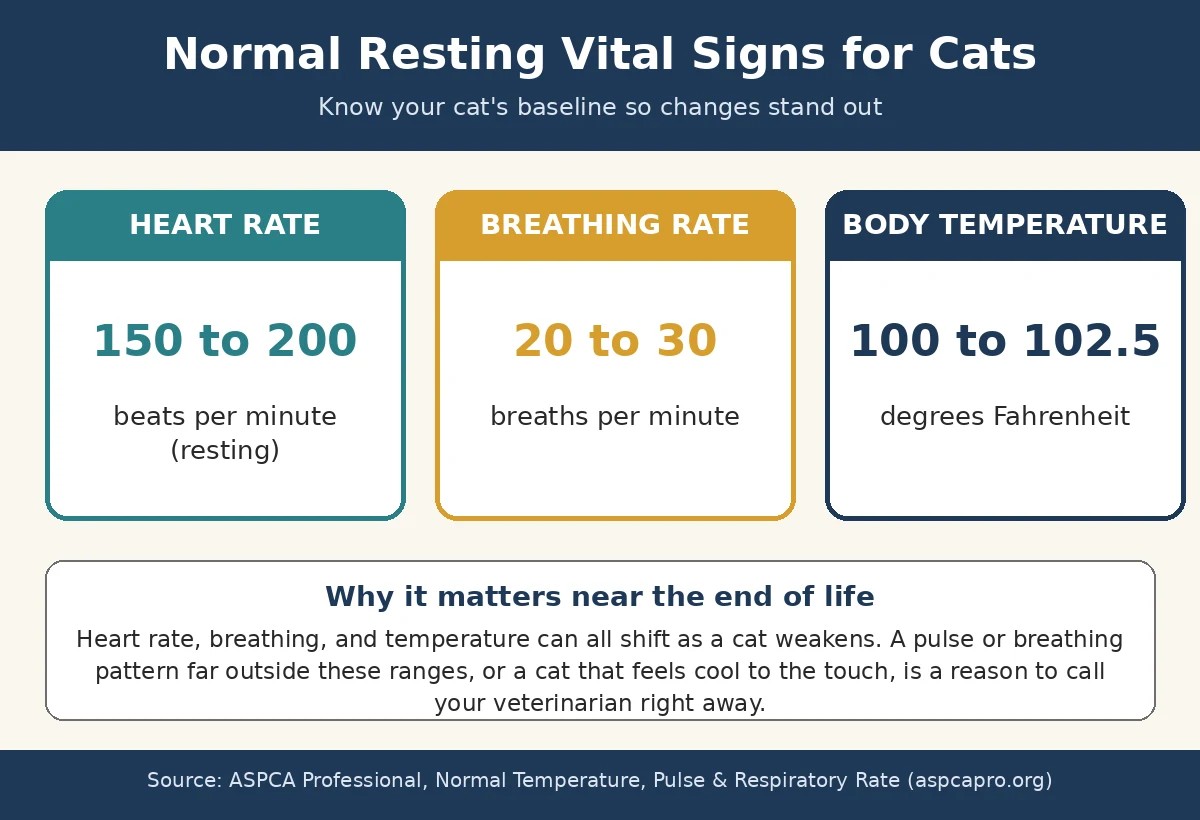
Reference ranges from ASPCA Professional, Normal Temperature, Pulse and Respiratory Rate.
4. Refusing Food and Water
Not every cat that stops eating is dying, but a drop in appetite always deserves a call to your veterinarian. Cats that skip meals for even a day or two can develop serious liver problems, so waiting is risky. Once treatable conditions are ruled out, a cat who refuses food and water may be nearing the end. Dehydration shows up as dry, tacky gums, skin that is slow to spring back when gently lifted, and darker, less frequent urine.
5. Foul Odor and Loss of Bladder Control
Cats are famously clean, so a strong smell is a red flag. In a very sick cat, waste products can build up in the body and change the odor of the breath, skin, and urine, and infections or unkempt fur add to it. Weakness can also make it hard to reach the litter box, and some cats lose control of the bladder and bowels. Clean accidents gently with a warm, damp cloth, use absorbent pads under bedding, and move a low-sided litter box close to where your cat rests.
6. Personality Changes
A cuddly lap cat may turn irritable or snap when touched, because familiar handling can suddenly hurt. Other cats do the opposite: an independent cat may follow you from room to room and refuse to leave your side. Whichever way your cat changes, respond to what they ask for, whether that is space or company, and handle them gently and slowly.

7. Extreme Weakness and Lethargy
As the end approaches, energy drops sharply and most cats spend nearly the entire day asleep. You may notice that your cat no longer jumps onto the couch, wobbles when walking, or struggles to stand. Place bedding, water, and a litter box within a few steps of where your cat rests, and add a ramp or low step if they still want to reach a favorite spot.
8. Hiding
Cats feel safest alone when they feel unwell. Outdoor cats may tuck themselves under a porch or into bushes, while indoor cats pick closets, the space under stairs or beds, or quiet corners away from household traffic. Avoid pulling your cat out. Instead, set a comfortable bed, fresh water, and a litter box nearby and check in quietly several times a day.
9. Loss of Grooming
A cat who no longer grooms may develop matted fur, bald spots, dandruff, or a greasy, rumpled coat. Loss of grooming is often an early signal that your cat feels too weak or too sore to keep up with daily care. A soft brush and a warm, damp cloth can keep your cat clean and comfortable without causing stress.
10. Seizures and Tremors
Some cats have seizures near the end of life, particularly with advanced kidney or liver disease or a problem in the brain. A seizure can include convulsions, paddling legs, drooling, and yowling, and a cat may have several in the hours before death. Afterward, your cat may seem confused or may not recognize you for a while.
- Stay calm, dim the lights, and move anything hard or sharp out of the way.
- Never put your hands near your cat’s mouth.
- Time the seizure. One that lasts longer than five minutes, or several in a row, is an emergency.
Dying Cat Stages: What the Final Weeks, Days, and Hours Can Look Like
No two cats follow the same timeline, and the underlying illness changes the pattern, but caregivers and veterinarians often describe the decline in three phases.
Weeks Before: A Slow Decline
- Eating a little less and losing weight
- Sleeping more and playing less
- Grooming less, especially hard-to-reach areas
- Avoiding jumps, stairs, and the litter box lip
- Seeking quiet places away from the household
Days Before: Withdrawing From Food, Water, and Family
- Refusing food, or only licking at it, and drinking very little
- Hiding for long stretches or staying in one spot
- Unsteady walking, collapsing, and accidents outside the litter box
- Cool paws and ears and a noticeable odor
- Crying or restlessness, which can signal pain and is worth a same-day call to your veterinarian
Final Hours: Active Dying
- Slow, irregular breathing with long pauses or occasional gasps
- A cool body and a slowing, uneven heartbeat
- Little or no response to your voice or touch, sometimes described as a coma-like state
- Eyes that may stay partly open
- Release of urine or stool at or shortly after death
| Phase | What helps most |
|---|---|
| Weeks before | Schedule a veterinary visit, ask about pain relief and palliative care, and keep routines gentle |
| Days before | Keep your cat comfortable and warm, make food and water easy to reach, and talk with your veterinarian about euthanasia timing |
| Final hours | Stay close with a calm voice, keep the room quiet, and have your veterinarian’s after-hours number ready |
Normal Aging or Something More Serious?
Slowing down is part of getting older, and many senior cats stay happy and comfortable for years. The AAFP and AAHA define a senior cat as one over 10 years old, but they also note that the end-of-life stage can happen at any age, depending on health rather than the calendar.
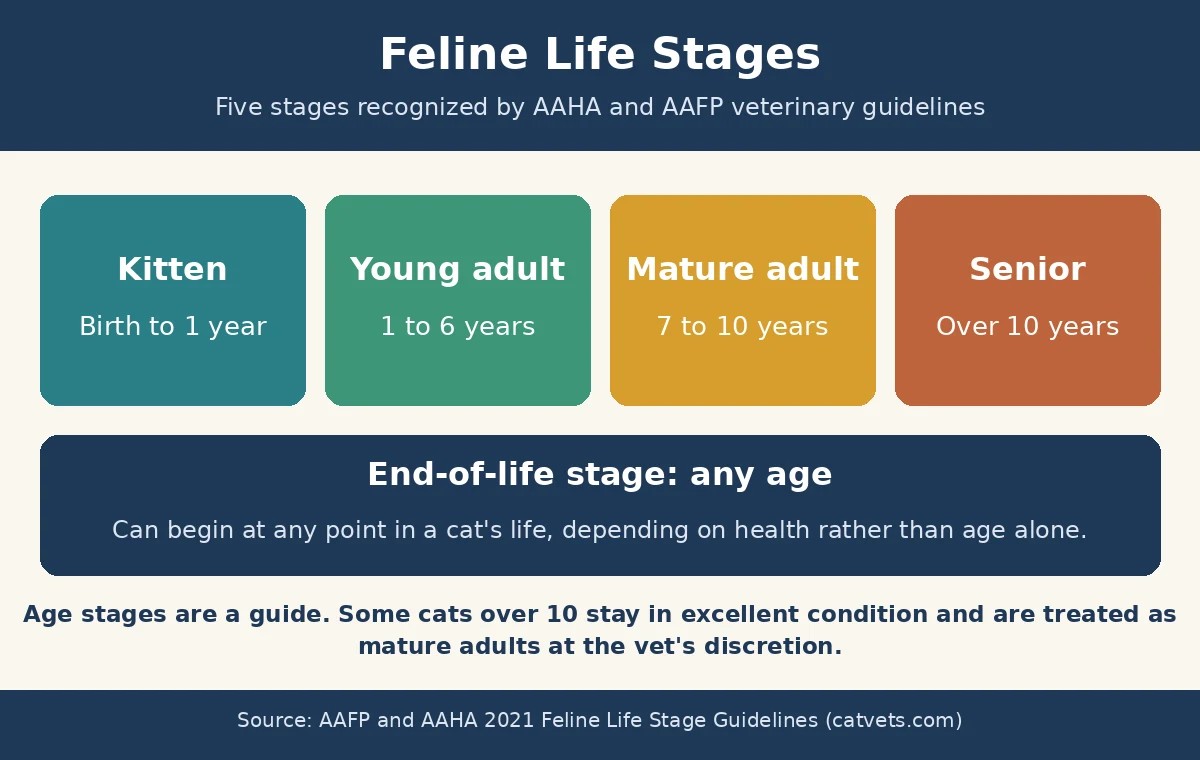
Life stages from the AAFP and AAHA 2021 Feline Life Stage Guidelines.
How to Tell Aging From Signs Your Cat Is Dying
The difference usually comes down to degree and speed. Normal aging changes happen slowly and your cat still enjoys favorite routines. The signs your cat is dying tend to arrive together and worsen quickly.
| Common with normal aging | Call your veterinarian right away |
|---|---|
| Sleeps more but still greets you | Barely responds or will not get up |
| Moves stiffly and jumps less | Cannot stand or walk steadily |
| Eats a bit less or prefers softer food | Refuses food and water for a day or more |
| Grooms less in hard-to-reach spots | Stops grooming, mats badly, or smells foul |
| Slower and quieter | Fast, labored breathing or seizures |
Kidney disease, hyperthyroidism, diabetes, dental pain, and arthritis can all mimic the end of life while being manageable, so a veterinary exam is always worth it before assuming the worst.
How to Judge Your Cat’s Quality of Life
When a cat is very sick or very old, a quality of life scale gives you something concrete to talk through with your veterinarian. The most widely used tool is the HHHHHMM scale, created by veterinary oncologist Alice Villalobos. It rates seven areas, Hurt, Hunger, Hydration, Hygiene, Happiness, Mobility, and More good days than bad, from 1 to 10, with 10 being ideal. The Merck Veterinary Manual publishes the scale in a reference table veterinarians use.
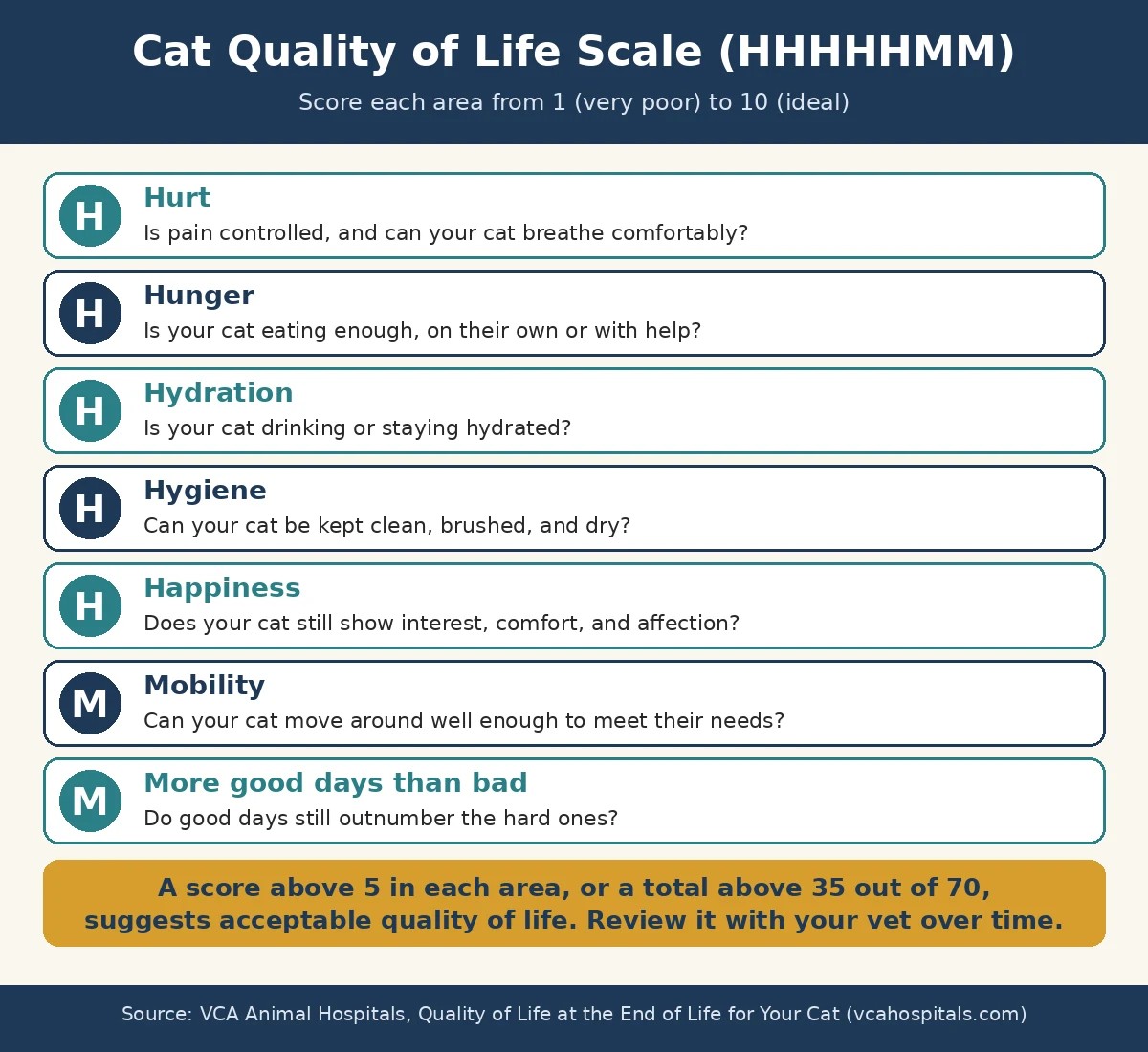
Scale and scoring guidance from VCA Animal Hospitals, Quality of Life at the End of Life for Your Cat.
Score your cat once a week, mark each day on a calendar as good or hard, and watch the trend rather than any single day. Scoring each area above 5, or a total above 35 out of 70, suggests an acceptable quality of life, while a steady decline or too many bad days in a row is a signal to talk with your veterinarian. As the Cornell Feline Health Center points out, there are no strict guidelines for this decision, and it is made jointly by the caregiver and the veterinarian.
How to Comfort a Dying Cat at Home
Comfort care matters at every stage. Small changes to your cat’s space can ease pain, reduce stress, and make the time you have left more peaceful.
- Offer a soft, warm bed in a quiet room, away from loud appliances and busy walkways.
- Keep fresh water, favorite foods, and a low-sided litter box within a few steps.
- Ask your veterinarian about pain relief, anti-nausea medication, and fluids to keep your cat comfortable.
- Handle your cat gently, and let them decide how much touch they want.
- Keep other pets and young children calm and give your cat space to retreat.
- Stick to familiar routines, familiar smells, and a calm, steady voice.
When to Call an Emergency Veterinarian
- Open-mouth breathing, gasping, or pale, blue, or gray gums
- A seizure that lasts longer than five minutes, or repeated seizures
- Sudden collapse or an inability to stand
- Crying out, restlessness, or signs of severe pain
Caring for a dying cat is emotionally heavy. You may find it helps to read resources for coping with the loss of a pet while you are still in the middle of caregiving, and to lean on friends or family who understand what your cat means to you.
Talking With Your Veterinarian About Euthanasia
When treatment can no longer relieve suffering, euthanasia can be a final act of care. The Cornell Feline Health Center explains that euthanasia is an option when a cat is seriously ill and in pain and treatment alternatives have run out, and that veterinarians are typically sensitive to the needs of the owner afterward. Many clinics allow you to stay in the room and take as much time with your cat as you need.
It helps to arrive with questions in mind:
- Is my cat in pain, and can it be controlled with medication?
- Which of my cat’s symptoms can still be treated?
- What will the procedure be like, and can I stay with my cat?
- Do you offer euthanasia at home or at a quiet time of day?
- What are my options for my cat’s remains afterward?
It is also kind to yourself to decide on aftercare before the day arrives, so that you are not making rushed decisions while grieving.
Planning Your Cat’s Final Arrangements
After a cat passes, families usually choose between a veterinary clinic’s standard handling, cremation, burial where local rules allow, or a lasting memorial. Families who want a keepsake can talk with Animal Family Pet Preservation about what is possible for their cat.
Cremation Options for Your Cat
Cremation gives many families a gentle way to keep their cat close. You can read about cremation options for companion animals to understand the choices and questions to ask before you decide.
Because every cat and every family is different, take the time to learn how cremation arrangements for cats are handled so that the arrangement fits what you want.
Lifelike Preservation as a Lasting Keepsake
Some families want something they can see and touch, which is why they look into preserving your cat as a lifelike keepsake. Every finished memorial from our studio is backed by a lifetime guarantee, and we ship nationwide. Timing matters for preservation, so it is wise to reach out to our team before or right after the loss so we can explain how to care for your cat in the meantime.
When you are ready to compare options, you can review how pricing and nationwide shipping work before you make a decision.
Frequently Asked Questions About a Dying Cat
How do I know if my cat is dying?
Look for several changes happening together, such as refusing food and water, extreme weakness, hiding, a drop in body temperature, labored breathing, and a loss of grooming. No single change proves a cat is dying, and some of these signs can come from treatable illness, so a veterinarian should examine your cat to confirm what is happening and whether comfort care or treatment can help.
What are the stages of a dying cat?
Many cats decline in phases. Over weeks, they eat less, sleep more, and groom less. Over days, they withdraw, hide, and take very little food or water. In the final hours, breathing becomes slow and irregular, the body feels cool, and the cat may become unresponsive. Timelines vary with the cat and the illness, so your veterinarian can give the best estimate for your cat.
Do cats have seizures before they die?
Some do, particularly when advanced kidney disease, liver disease, or a problem in the brain is involved. A seizure can look like convulsions, paddling legs, drooling, or yowling. Keep your cat away from stairs and hard edges, do not put your hands near the mouth, and note how long it lasts. A seizure that lasts longer than five minutes, or several seizures in a row, is an emergency.
What is a normal heart rate for a cat, and what changes near the end of life?
The ASPCA lists a normal resting heart rate for cats at 150 to 200 beats per minute. Near the end of life, the heartbeat may race at first when a cat is in pain or struggling to breathe, then slow and become irregular as the body weakens. A veterinarian can check your cat’s heart and tell you whether the changes you feel are cause for concern.
Do cats know when they are dying?
No one can say for certain. Very sick cats often hide, seek solitude, or become unusually clingy, which may reflect how unwell they feel rather than an understanding of death. Either way, a quiet space, gentle contact on your cat’s terms, and good pain control are the most helpful things you can offer.
When is it time to consider euthanasia for a cat?
There is no strict rule, and the decision is usually made together by the caregiver and the veterinarian. A quality of life scale can help you look at pain, appetite, hydration, hygiene, happiness, mobility, and whether good days still outnumber bad ones. Uncontrolled pain, trouble breathing, and refusing food and water are reasons to talk with your veterinarian right away.
Should I stay with my cat at the end?
Many caregivers find comfort in being present, and cats are often calmer with a familiar voice and gentle touch nearby. Veterinarians commonly allow owners to stay in the room during euthanasia and to take time with their cat afterward. Choose what feels right for you, and ask your veterinarian what to expect so nothing comes as a surprise.
Honor Your Cat With a Memorial You Can Keep
If you are facing the loss of your cat, you do not have to figure out the next steps alone. Our team can answer questions about memorial options and walk you through what to expect.
Categorised in: Deceased Pet Options
This post was written by Animal Family Team



Comments are closed here.